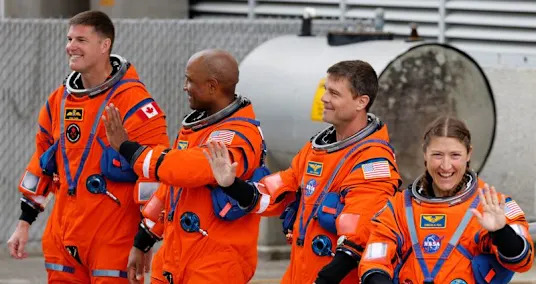
April 1 (Reuters) - All three NASA astronauts on the Artemis II lunar mission are veterans of Earth-orbit science expeditions to the International Space Station, while the lone Canadian joining them on a voyage around the moon and back is a spaceflight rookie.
Here are some highlights from the careers of mission commander Reid Wiseman, pilot Victor Glover and mission specialist Christina Koch, all U.S. astronauts, and Canadian astronaut Jeremy Hansen, also a mission specialist.
MISSION COMMANDER REID WISEMAN
Wiseman, 50, logged 165 days aboard the International Space Station during a 2014 mission, flying to the orbiting platform aboard a Russian Soyuz spacecraft. A former U.S. Navy test pilot, he later served as NASA's chief astronaut before being selected to command Artemis II.
PILOT VICTOR GLOVER
Glover, 49, spent 168 days in orbit beginning in 2020 as pilot of NASA's Crew-1 flight, the first full-fledged ISS mission using SpaceX's Crew Dragon capsule to carry astronauts to the space station. Before joining NASA, he flew more than 40 aircraft during a U.S. Navy career that included combat deployments and test-pilot duties. A veteran of four spacewalks, he is the first Black astronaut ever to be sent on a lunar mission.
MISSION SPECIALIST CHRISTINA KOCH
Koch, 47, set a record in 2019 for the longest continuous spaceflight by a woman, spending 328 days aboard the ISS, and was part of NASA's first three all-female spacewalks. Trained as an electrical engineer and physicist, she previously worked as a NASA engineer and carried out extended research expeditions in Antarctica. She is the first woman to fly on a moon-bound mission.
MISSION SPECIALIST JEREMY HANSEN
Hansen, 50, a Royal Canadian Air Force colonel, is the first Canadian, and first non-U.S. citizen, sent on a lunar mission even as he makes his own first spaceflight. He was selected for Canada's astronaut corps in 2009, and his seat aboard Artemis II reflects a long-standing U.S.–Canadian partnership in human spaceflight, including Canada's contributions to robotics used aboard the ISS.
(Compiled by Joey Roulette in Cape Canaveral, Florida and Steve Gorman in Los Angeles; Editing by Jamie Freed)
LATEST POSTS
- 1
 Forum Dvorah demands clear support for women in combat as IDF gender debate escalates
 - 2December's overlooked meteor shower peaks next week — will the Ursids surprise us?
- 3Do-It-Yourself Home Style on a Careful spending plan: Imaginative Thoughts and Tasks
- 4NASA wants to build a base on the Moon by the 2030s – how and why it plans to build up to a long-term lunar presence
- 5Most loved Solace Food: What's Your Definitive Comfortable Dinner?



- Solid Living Tips: Experiences from a Wellness Fan
- Instructions to Shield Your Gold Speculation from Possible Dangers: Fundamental Protections
- Interoceanic Train derails in southern Mexico, injuring at least 15 and halting traffic on line
- Why boosting production of Venezuela's 'very dense, very sloppy' oil could harm the environment
- Mobility exercises are an important part of fitness as we age. Here are some tips
- Top notch Remote Earphones for Audiophiles
- 'Heated Rivalry' is just the tip of the iceberg. How hockey became the sexiest sport
- Pacific voyagers’ remarkable environmental knowledge allowed for long-distance navigation without Western technology
- War in Iran could exacerbate German housing crisis, minister warns