When you buy through links on our articles, Future and its syndication partners may earn a commission.

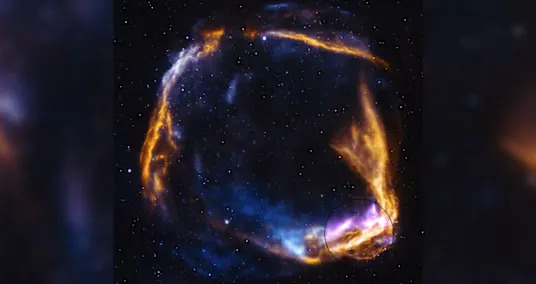
A NASA X-ray telescope has captured a breathtaking portrait of a supernova remnant, revealing unseen features of the exploded star.
What is it?
This image depicts the supernova remnant SN 185, found some 8,000 light-years away from Earth in the direction of the sun's closest sibling, the triple star Alpha Centauri. Based on historical records made by Chinese astronomers, scientists believe the star exploded in the year AD 185. It may have been visible in the sky for as many as eight months.
In this new image, NASA's Imaging X-ray Polarimetry Explorer (IXPE) observatory helped astronomers study the outer rim of this object (also known as RCW 86) and discover that the expansion of the remnant's gases appears to have stopped in the region NASA has highlighted by a purple ring in the image.
Astronomers have previously found that a large low-density "cavity" in the center of the supernova caused it to expand more rapidly than they would normally expect, and now IXPE's new observation of this outer rim helps "fill in a fuller picture of what other telescopes have observed," NASA wrote in a statement accompanying the image.
Why is it amazing?
IXPE captured the image using its unique ability to study the polarization of X-rays, or how waves of X-ray light oscillate relative to their direction.
By studying this polarization, IXPE can help astronomers probe some of the deepest mysteries of the cosmos, such as why black holes spin, what powers the extreme jets blasting from supermassive black holes, or why pulsars glow so brightly in X-ray light.
IXPE launched on Dec. 9, 2021, from NASA's Kennedy Space Center in Florida atop a SpaceX Falcon 9 rocket. In its first four years of operation, it has studied a black hole's "heartbeat", observed supernova remnants, and peered into the magnetic fields of neutron stars.




 The Response to Self-improvement: Embracing a Development Outlook
- Step by step instructions to Streamline Your Dozing Involvement in a Savvy Bed
- How to track NASA’s Artemis II and Orion’s journey to the moon
- Kids with smartphones by age 12 are at higher risk of health issues, study finds
- Craig the beer-ambassador elephant dies aged 54
- What an expert on the gut microbiome eats in a day
- Merck urges science-led US vaccine schedule after CDC trims childhood vaccine list
- Motivational Travel Objections for History Buffs
- 2026 will be the year NASA astronauts fly around the moon again — if all goes to plan