When you buy through links on our articles, Future and its syndication partners may earn a commission.

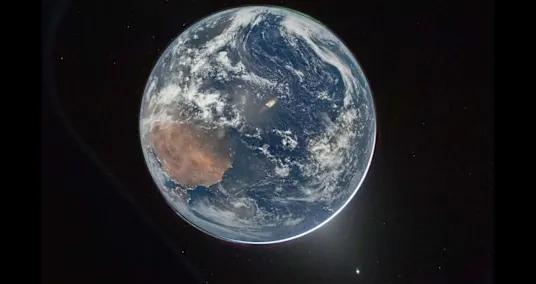
The Artemis 2 astronauts have shared a view that the billions of us stuck on Earth will never get firsthand: a gorgeous shot of our home planet shining like a sapphire in the blackness of space.
What is it?
This photo shows Earth as seen from Artemis 2's Orion spacecraft, which on Thursday evening (April 2) aced a crucial engine burn that took it out of Earth orbit and toward the moon.
The Artemis 2 astronauts — NASA's Reid Wiseman, Victor Glover and Christina Koch, and the Canadian Space Agency's Jeremy Hansen — have since been watching Earth recede into the distance, and NASA shared one of their photos today (April 3) on the social media site X.
"We see our home planet as a whole, lit up in spectacular blues and browns. A green aurora even lights up the atmosphere. That's us, together, watching as our astronauts make their journey to the moon," NASA officials wrote in the X post.
Why is it amazing?
The photo by itself is amazing enough, showing our planet as it truly is — a shimmering, fragile outpost of life in a vast and dark cosmos. But the connection to Artemis 2 makes it even more special.
Artemis 2 is the first crewed moon mission since Apollo 17 back in 1972. If all goes to plan, Wiseman, Glover, Koch and Hansen will loop around the moon on Day 6 of the mission, which lifted off on April 1. They'll come back to Earth for a splashdown on Day 10.
Artemis 2 won't land on the moon or even enter lunar orbit. It's designed to pave the way for those milestones, and in fact even more ambitious ones: NASA's Artemis program aims to build a base near the lunar south pole in the early 2030s.
Keep tabs on the mission's latest developments with our Artemis 2 live updates page.





 Iranian strikes on Israel injure 11 and set chemical plant ablaze
- Former hostage Eitan Mor on Hamas: ‘They will not give up until the last Israeli is gone'
- Instructions to Choose the Best Web based Advertising Degree Program for Your Objectives
- Satellite data reveals a huge solar storm in 2024 shrank Earth's protective plasma shield
- Scientists dove hundreds of feet into the ocean and found creatures no human has ever seen. Our trash beat us there
- Moderna to complete US mRNA manufacturing network with $140 million investment
- Holyvolt And Wildcat Could Help The West Reclaim Battery Leadership
- Proficient Cultivating Devices for a Lovely and Useful Nursery in 2024
- UK can legally stop shadow fleet tankers, ministers believe